A communication protocol for rehearsing in earplugs

On this page
A Shared Protocol for Rehearsing in Earplugs
The Real Problem Is a Missing Process
Most groups that struggle to talk in rehearsal with earplugs in blame the earplugs. Usually the cause is simpler: nobody agreed on what happens when the music stops. One player keeps noodling, a second starts explaining a fix, and a third, standing across the room, catches half a sentence and guesses the rest. Everyone then spends the next few minutes untangling who meant what.
Take the earplugs out of that scene and the same mess shows up, only quieter. Earplugs just make it harder to ignore. When you can’t count on overhearing a stray comment, you need a routine that every person in the room recognizes. That routine is a communication protocol, which is simply a set of agreed habits for how information moves around the group.
The approach below suits bands, worship teams, school ensembles, and any other group that rehearses at a volume where hearing protection makes sense. Adapt the details to your room and your people. What matters is that everyone follows the same steps every time.
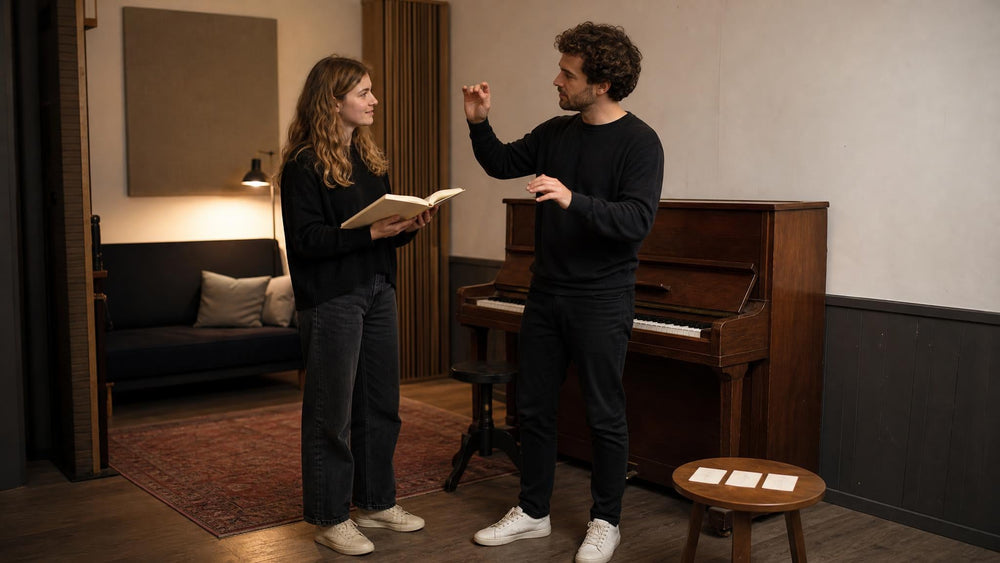
 Photo by cottonbro studio / Pexels
Agree on One Way to Stop the Music
Start with the moment of the pause. If a rehearsal has three different ways of stopping, you will get three different reactions: half the group trails off, a few finish the phrase, and one person plays on because they never noticed.
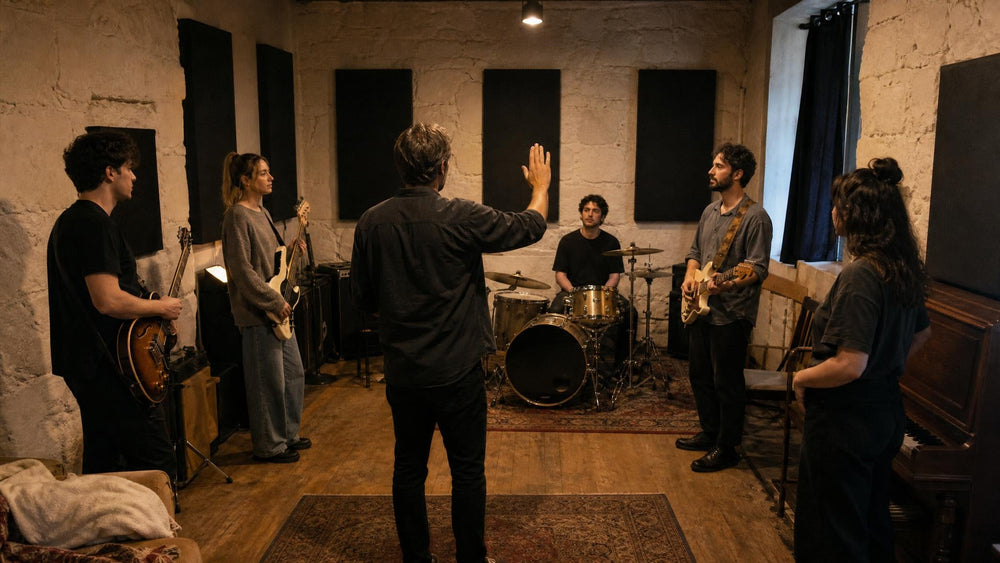
Pick a single stop signal and use it for every interruption. Whoever is leading the rehearsal, whether that’s a bandleader, a director, or the person running the session, gives the signal. A raised hand, a clear cut-off gesture (the conductor’s motion that tells everyone to end a note together), or a pre-arranged visual cue all work. Choose something that can be seen from every seat, not just from the front.
Then agree on what the signal demands: everyone stops, instruments down or silent, and eyes up. That last part matters. In earplugs, people lean on their eyes more than usual, so the pause should be the moment the whole room turns toward whoever is about to speak.
If anyone other than the leader can call a stop, say so up front and decide how. A player who hears a wrong chord or a dragging tempo shouldn’t have to wait for permission, but they also shouldn’t start a side conversation mid-song. A simple rule helps: anyone can raise a hand, and the leader decides whether to stop.
Give Instructions Once, in Order, From One Person
After the stop, the next failure point is the explanation itself. Several people talking at once, or one person talking while others tune or test a sound, guarantees that part of the room misses the message.
Set a few ground rules for the pause:
- One speaker at a time. The person who called the stop gives the correction. Others wait until they finish.
- Instruments quiet. No fiddling, no quiet runs through a tricky passage. Silence helps everyone hear through the plugs.
- Say where, then what. Name the location in the music first, then the change. “Bar 17, second verse, drums drop out on the last beat” is easier to follow than a description with no anchor. Because people need a moment to find their place, the location has to come before the instruction.
- Keep it short. If the explanation grows long, it probably belongs in a separate conversation, not in the middle of a run-through.
Speak toward the group rather than toward the one person you’re correcting, and face the room so people can see your mouth. Earplugs flatten some of the detail in speech, and watching a speaker’s face fills in the gaps.
 Photo by RDNE Stock project / Pexels
Confirm That People Heard You
An instruction nobody acknowledges is an instruction you can’t assume was received. Build in a quick confirmation before you play again.
This doesn’t have to be elaborate. A thumbs-up from each section, a nod around the room, or a quick repeat-back from the person affected is enough. If the correction was aimed at the bass player, ask them to say it back in a few words. If someone across the room looks puzzled, you’ll see it right then, not three minutes later when the same mistake happens again.
Make it normal to say “I missed that.” In a group that rehearses in earplugs, nobody should feel awkward about asking for a repeat. The leader can help by inviting it: a quick “Anyone need that again?” costs a few seconds and saves a failed take.
Make the Restart Unmistakable
Once the correction is understood, the group has to start again together, and here the loose ends tend to multiply. People disagree on where to begin, who counts in, and how fast.
Settle three things out loud before every restart:
- The starting point. Name the bar, section, or lyric line. If you use letters or numbers on the charts, use those labels consistently.
- Who gives the count-in. A count-in is the spoken or played beat count that sets the tempo before the music begins. Decide who provides it, and have that person do it the same way every time.
- Who plays and who sits out. If only part of the group is restarting, say which players are in. Everyone else stays quiet until their entrance.
Having one person who gives the count and one gesture to start keeps entrances tight even when ears are partly covered. Everyone should be looking at the same person when the music begins.
Practice the Protocol Like Any Other Skill
A protocol that lives only in a conversation will fall apart by the second week. Treat it as part of the rehearsal routine, not a one-time announcement.
At the first session, walk through it explicitly. Show the stop signal, practice a pause-and-explain cycle, and run a restart a few times until it feels automatic. It may seem overly formal for a few minutes, but groups usually relax into it quickly because it removes the guesswork.
Afterward, check in. Ask what worked and what caused confusion, then adjust. Maybe the hand signal is hard to see from the back, or the count-in person keeps getting drowned out. Fix those details and tell everybody what changed. Write the final version down and keep it somewhere easy to find, such as on a shared note or taped inside the rehearsal room.
Finally, bring new members up to speed right away. A single person who doesn’t know the routine can undo the benefits for everyone else.
The goal is not to turn rehearsal into a rulebook. It’s to make the boring parts of rehearsing, stopping, explaining, and restarting, so predictable that people can leave their earplugs in and spend their attention on the music.
Sources
A communication protocol for rehearsing in earplugs, www.soundbrenner.com