Keep your base IEM mix: note only the song-specific changes


On this page
Keep Your Base IEM Mix and Write Down Only the Exceptions
“Give me more lead vocal” sounds like a clear request. Over a full set, it stops being useful. Which singer do you mean? In whose ears? For the whole song, or just the quiet bridge? If none of that is written down, the person running monitors has to remember every arrangement while also guessing what each request meant. Meanwhile, musicians may carry a tweak from one song into the next without noticing, and the mix drifts away from what worked.
The fix is simple: build one solid base mix, then keep a short list of exceptions for the songs that need something different.
What a Base Mix and an Exceptions List Are
IEMs, or in-ear monitors, are the small earpieces that deliver your personal monitor mix on stage. The monitor operator (sometimes called the monitor engineer) builds that mix at a console, and it’s usually sent separately to each player.
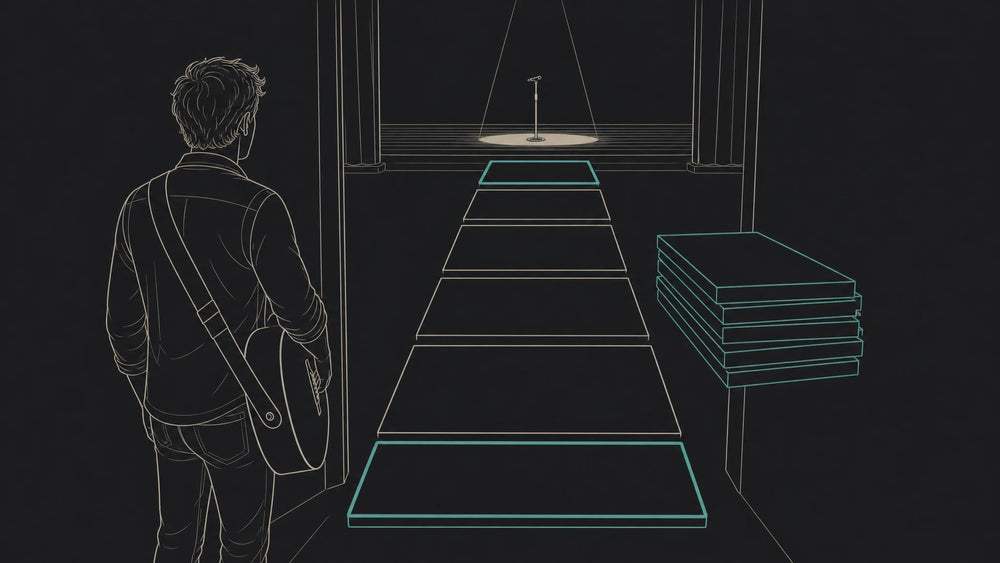
Your base mix is the balance that works for most of your set: the level of your own instrument, the vocals, the rhythm section, and whatever else you need to play comfortably. Think of it as home position. Every song starts there.
An exceptions list is a short written record of the places where a particular song needs something other than home position. It doesn’t describe the whole mix again. It only captures what’s different.
This split matters because it protects the part of your mix that’s already working. Instead of reshaping the whole mix every time something feels off, you leave the foundation alone and make small, labeled adjustments on top of it.
 Photo by Dmitry Demidov / Pexels
Why Vague Requests Cause Trouble
Consider what a loose note like “more vocal” leaves open:
- Which voice? The lead singer, a backing vocalist, or a harmony part?
- Whose mix? Your ears only, or everyone’s?
- Which part of the song? The entire track, or one section like a bridge where the band drops down?
- How should it end? Does it stay changed, or return to normal afterward?
Without answers, the operator has to fill in the blanks. They may get it right, or they may fix a problem you didn’t have. Worse, a change meant for one quiet section can get applied to a whole song, or to the next song too. Then you’re chasing a new problem that came from fixing the old one.
A written exception answers those questions before anyone has to ask them.
How to Write a Useful Exception
Keep each entry short, but make sure it covers the same few points every time:
- Song. Name the song the note applies to.
- Section. Say where in the song the change happens: a verse, a chorus, a bridge, an intro. If it’s the whole song, say so.
- Source. Name exactly what needs to change, such as the lead vocal, a specific backing singer, or a particular instrument.
- Whose ears. State whose mix is affected. If it’s only yours, say that.
- Direction. Say whether it needs to go up or down. If you can, relate it to your base mix rather than describing an absolute sound.
- Return. Note when the mix should go back to the base.
An entry might read like: “Quiet bridge, lead vocal up in my mix only, back to base at the final chorus.” It’s brief, but a monitor operator can act on it without guessing and without needing to ask you mid-song.
Notice what’s missing: you aren’t restating guitar level, drums, bass, or anything else that’s already fine. If it isn’t different, it doesn’t belong on the list.
 Photo by cottonbro studio / Pexels
Keeping the Changes Targeted and Reversible
The goal isn’t just clarity. It’s also making sure every change can be undone cleanly.
Because the base mix stays untouched, every exception has a natural way back. When the song ends, or the section passes, the operator returns to the base. Nobody has to remember what the mix looked like before, because that mix never went away.
A few habits keep this working:
- Change one thing at a time. If you stack several adjustments into a single note, you can’t tell which one helped or hurt.
- Prefer small, specific moves over broad ones. Raising one source in one section is easier to evaluate than reshaping the mix.
- Don’t fix the base to solve a one-song problem. If something only matters in a single song, it’s an exception. Altering the base to accommodate it will cause trouble in every other song.
- Watch for patterns. If the same exception keeps showing up across many songs, that’s a sign the base mix itself needs adjusting. Revise it deliberately, in rehearsal, rather than patching it song by song.
Making It Part of Your Routine
The list only helps if it’s easy to use, so keep it simple and keep it shared.
Write it where the operator can see it. A short note in the setlist or a shared document works better than something said once during soundcheck. Memory fades quickly, especially in the middle of a busy rehearsal.
Tie notes to the setlist order. Since each exception belongs to a particular song, putting them next to the song titles makes them easy to find in the moment.
Review after each rehearsal. Look at which exceptions actually helped. Remove the ones that no longer matter, and tighten the wording on the ones that caused confusion. A list that grows without pruning stops being short, and a long list loses the clarity that made it worth keeping.
Confirm the return. When an exception is applied, make sure everyone knows it ends. A change that quietly lingers into the next song is exactly the problem this approach is meant to prevent.
Agree on wording as a band. If everyone uses the same terms for sections and sources, such as the same name for a bridge or the same label for each singer, requests become faster to write and faster to read.
The Takeaway
A strong IEM mix is a stable starting point, not something you rebuild for every song. Protect your base mix, and when a song truly needs something different, write down only what changes: which song, which section, which source, whose ears, and when it goes back. The result is a mix you can trust, a monitor operator who isn’t guessing, and fewer surprises from one song to the next.
Sources
Keep your base IEM mix: note only the song-specific changes, www.soundbrenner.com