Holiday music distribution deadlines for 2026

On this page
Start Early: The Holiday Rush Is Real
Late November through New Year’s Day is a great time to put out music. Listeners are looking for seasonal songs, and fans are in a good mood. The catch is that every other artist has the same idea, and the streaming platforms get buried in new submissions.
That volume is why last-minute uploads are risky this time of year. If your release reaches a platform late, it may not be live on the day you promised your listeners. For a holiday single, a missed date can mean the moment has passed.
The advice for a release between November 27, 2026, and January 1, 2027 is simple: submit at least six weeks before your planned release date. Anything tighter raises the odds of a delay.
Work Backward From Your Release Date
Pick the day you want your music to go live, then count back six weeks. That’s the latest you should send your release to your distributor. In this case the distributor is CD Baby, which reviews your submission before passing it along to the platforms.
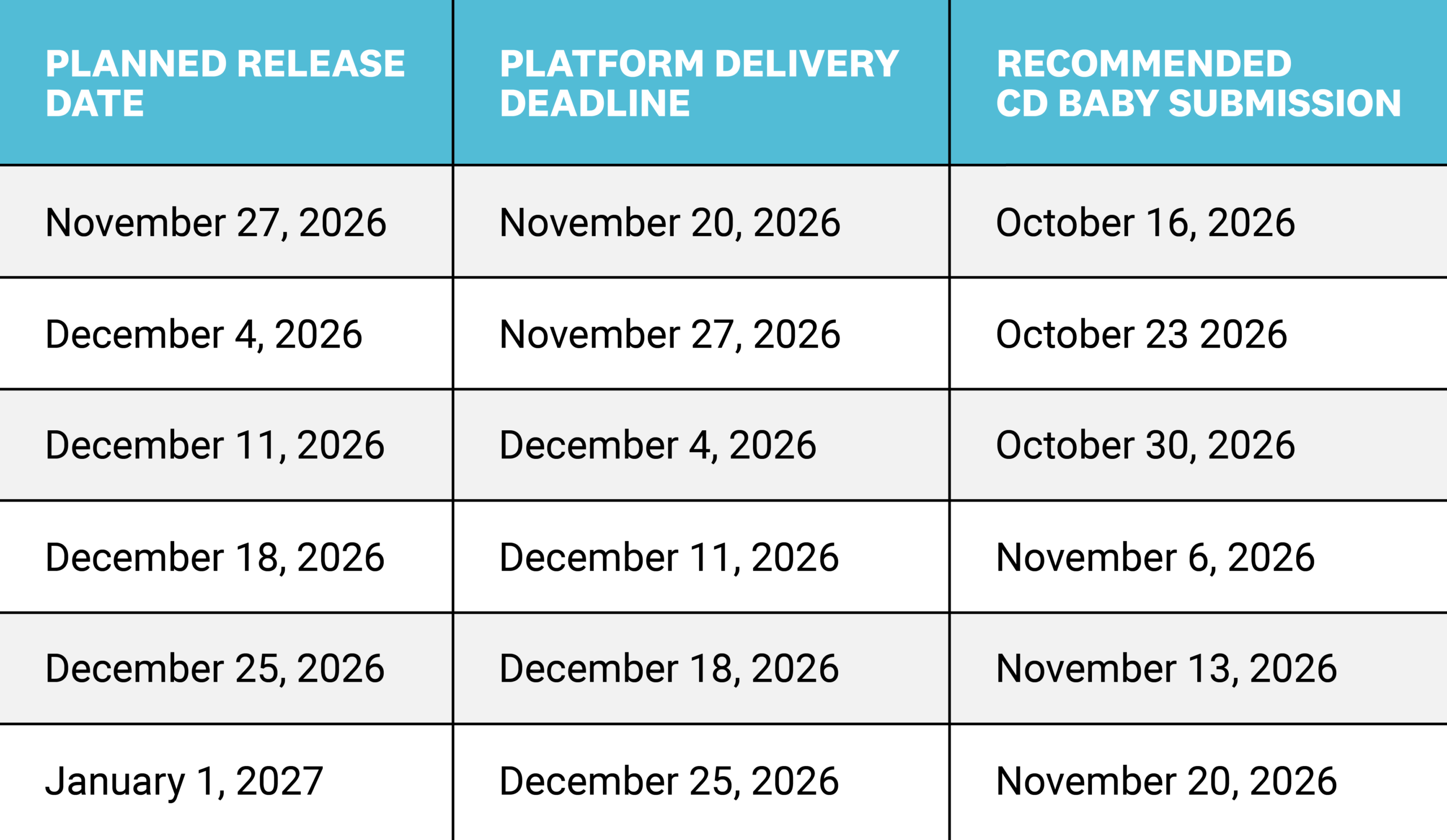
It helps to understand that there are two separate deadlines:
- The recommended submission date is when you should get your release to CD Baby for review.
- The platform delivery deadline is when your release has to arrive at the streaming platforms in order to go live on your target date.
The original article includes a chart listing both dates for each release window, so check it against your own date. Keep in mind that platforms don’t all process music at the same speed. Making the delivery deadline doesn’t guarantee your music will be live on your chosen day. Treat the deadlines as the last possible moment, not the target. Submitting earlier is the safest way to cover yourself.
A practical way to use this: put your submission date on your calendar, then add a personal deadline a week or so ahead of it for finishing the mix, artwork, and paperwork. Slipping a little on that personal deadline won’t sink your release.
 Via diymusician.cdbaby.com
Sort Out Licensing Before You Upload
Holiday releases often include covers. A cover is your own recording of a song someone else wrote. If you plan to distribute a cover across multiple platforms, you may need a mechanical license, which is permission from the songwriter’s side to reproduce and distribute their composition in your recording.
CD Baby offers a tool called Easy Song that can secure cover licenses for most songs. Their Help Center also has an article covering the licensing requirements in more detail. Get this handled early, since you don’t want a licensing question holding up a release that’s otherwise ready.
Samples are a separate matter
If your track includes a sample, meaning a piece of someone else’s existing recording, the rules are stricter. You need permission from the rights holders of both the recording itself and the underlying composition. That means two sets of permissions, not one. The original article links to a guide on clearing samples legally, and it’s worth reading before you build a track around a borrowed snippet.
Public domain songs
Many classic seasonal songs are old enough that nobody holds a copyright on them anymore. Songs published before January 1, 1927 have a good chance of being in the public domain, which means you can record and release a cover without a license.
Notice the wording, though: a good chance, not a guarantee. Always confirm the copyright status of the specific song you’re recording. The article points to pdinfo.com, which has a list of public domain songs and more background on the topic. Check the particular arrangement or version you’re working from, not just the title.
Give Your Metadata and Files a Final Review
Before you hit submit, go through everything one more time. Metadata is the information that describes your music, such as the artist name and track titles. Errors there tend to follow a release around, and fixing them under deadline pressure is no fun.
Run through this list:
- Confirm the artist name is spelled the way you want it to appear everywhere.
- Check each track title for typos and consistent formatting.
- Listen to the final audio files once more to make sure they’re the versions you intend to release.
- Look at your cover art to make sure it’s the right file and looks the way you expect.
It’s tempting to skip this when the clock is running, but a few minutes of review beats having to correct a live release.
 Photo by Pavel Danilyuk / Pexels
Use the Lead Time to Promote
Submitting six weeks early may feel like a long wait. Use that gap for promotion. Letting fans know what’s coming helps you keep your momentum and gives your release a better shot at strong streams during a crowded stretch of the year.
You can scale your promotion to the time and energy you have:
- Social media: Post an announcement about your release. CD Baby has a list of ten ideas for these posts if you need inspiration.
- Email: Send your fans a message about the upcoming release. Following best practices for email lists will help you get the most out of it.
- A full campaign: If you want to go bigger, CD Baby offers a 30-day release campaign plan as a starting point.
Even if you only do the first one, announcing ahead of time beats staying quiet until release day.
Your Holiday Release Checklist
Here’s everything in one place:
- Submit your release at least six weeks before the date you want it live.
- Secure any licenses you need for cover songs, and get clearance for any samples.
- Double-check that any public domain song is actually public domain.
- Review your metadata, audio, and cover art before submitting.
- Promote the release in the weeks leading up to launch.
The holidays are a good time to connect with listeners through your music. A little planning now means your release will arrive on schedule instead of landing after everyone has moved on.
Sources
Holiday music distribution deadlines for 2026, diymusician.cdbaby.com