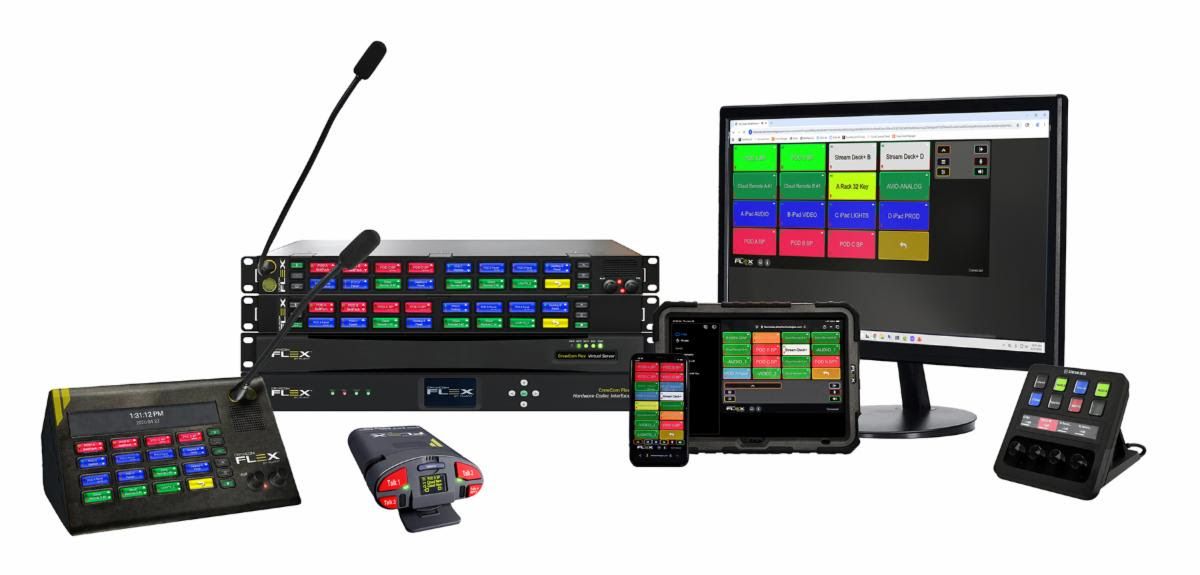
Pliant Technologies Begins U.S. Shipping Of CrewCom Flex

On this page
Pliant’s CrewCom Flex Intercom Is Now Shipping in the U.S.
Pliant Technologies has started shipping its CrewCom Flex intercom line to customers in the United States. If you run sound or stage crews for a community theater, a festival, a house of worship, or a band with a real production team, an intercom is the system that lets everyone talk to each other during the show. This one takes a different approach from the traditional design, so it helps to understand what has changed.
What CrewCom Flex Is
CrewCom Flex is an IP-based intercom platform. “IP-based” means it moves audio over a standard computer network, the same kind of infrastructure that carries data around a building, instead of through dedicated point-to-point intercom wiring.
Pliant describes the system as a blend of three kinds of communication:
- Wired, through wired intercom panels, desktop panels, and wired beltpacks. A beltpack is the small body-worn unit a crew member clips on and talks through.
- Wireless, through the company’s existing CrewCom wireless technology.
- Virtual, through panels that run in a web browser or in an app.
Because all three live in one system, a person on a wireless beltpack, someone at a desk panel, and someone on a browser-based panel can in principle be part of the same communications setup. The company positions the line for broadcast, live events, sports, corporate AV, and general production work.
 Photo by george charry / Pexels
The Big Change: No Matrix Frame
The headline feature is that CrewCom Flex does not need a traditional matrix hardware frame. In a conventional intercom system, the matrix is the central box that routes everyone’s audio. Every panel and beltpack connects back to it, so it is the hub that decides who can hear whom. It’s a physical piece of gear that has to be bought, racked, powered, and sized for the job.
Pliant’s approach drops that central box. The system runs over network infrastructure that supports two standards, AES67 and SMPTE ST 2110. Here is what those names mean:
- AES67 is a standard that lets professional audio devices from different makers send audio over IP networks and understand one another.
- SMPTE ST 2110 is a family of standards for carrying professional media over IP. It comes out of the broadcast world, which explains why a product aimed at TV and sports production supports it.
You don’t need to memorize either standard. The practical point is that the product is built on open, widely used networking standards rather than a closed, proprietary box at the center.
Cloud or Local: Your Call
Pliant says deployments can run on either cloud-based or local infrastructure. In plain terms, you aren’t forced into one way of hosting the system.
- Local means the system lives on your own network, in your own building or venue.
- Cloud means parts of the system run on remote servers and are reached over the internet.
The source doesn’t say which setup suits which situation, and it gives no details about how either one is configured, so don’t assume specifics. If you’re considering the product, ask Pliant or a dealer how each option would work for your venue, and what it would demand of your network.
 Photo by yellow tioata / Pexels
What Pliant Says It Gains You
Gary Rosen, Pliant’s vice president of global sales, said the company is excited to start shipping to U.S. customers after what he called an overwhelmingly positive response since the product was introduced. He also said CrewCom Flex was designed from the ground up for the changing realities of modern production communications.
His argument for dropping the matrix frame comes down to four benefits:
- Greater flexibility. Without a fixed central box, the system isn’t tied to the limits of one piece of hardware.
- Lower total cost of ownership. That means the overall cost of owning and running the system over time, not only the purchase price.
- Simplified system management. There is less hardware to configure and keep track of.
- Nearly limitless scalability. The system can grow with the size of your production.
These are the company’s claims. Pliant didn’t publish figures, pricing, or capacity numbers in this announcement, so treat them as goals to test against your own situation, not guarantees.
Is This Relevant to You?
For a small band with no crew comms at all, probably not yet. This is a professional production platform, and the announcement targets broadcast, sports, live events, and corporate AV. But if you do any of the following, it’s worth knowing about:
- You help run production for a larger event, a school or church program, or a multi-person stage crew.
- You’re thinking about upgrading an aging intercom setup.
- You want some crew members on wireless beltpacks and others on a computer or phone.
If any of those fit, here are some practical questions to ask before committing:
- What does my network look like? Because the system rides on AES67 and SMPTE ST 2110 infrastructure, find out whether your existing network meets those requirements. Don’t assume it does.
- Who will manage it? Less hardware may mean simpler management, as Pliant says, but someone still needs to be comfortable with network-based gear.
- Cloud or local? Decide which fits your venue, your internet reliability, and your comfort level, then ask about the specifics of each.
- Which panel types do I actually need? The system supports wired panels, desktop panels, wired beltpacks, wireless, and browser- or app-based virtual panels. Count how many people need each kind of connection before you plan.
- What’s the true cost? Pliant emphasizes lower total cost of ownership, so ask for a full quote and compare it to what a conventional matrix-based setup would cost you over time.
The Bottom Line
CrewCom Flex is Pliant’s bet that crew communication no longer needs a central matrix box. By running over standards-based IP infrastructure, mixing wired, wireless, and virtual connections, and offering both cloud and local deployment, it aims to make intercom systems easier to grow and manage. Shipping has begun in the U.S., so dealers and Pliant can now answer the questions above. If your production is heading toward networked audio, it’s a product to keep on your list.
Sources
Pliant Technologies Begins U.S. Shipping Of CrewCom Flex, www.prosoundweb.com