Singer-Songwriter Richie Owens Takes Appalachian Music To UK Pubs With HK Audio

On this page
A Nashville Songwriter Hits the UK Circuit
Richie Owens, a singer-songwriter based in Nashville, recently took his blend of country, rock and punk across the UK for eight shows. The route took in Yorkshire, Oxfordshire and Merseyside. Two other musicians, Bob Ocker and Joe Sharp, joined him on stage.
For a small group, the interesting part of this tour is the practical side: how you get a decent sound in rooms that don’t give you one. Many of the venues had no sound reinforcement of their own. Sound reinforcement is the trade term for a PA (public address) system, meaning the speakers, amplification and mixing gear that make a live band audible to a whole room. With none on site, the band needed to bring its own.
Only a few details of the tour’s setup are public, so this piece sticks to them. It also uses the story as a springboard for general advice on running a compact PA for a small touring act.
The Rig: Two Column Loudspeakers
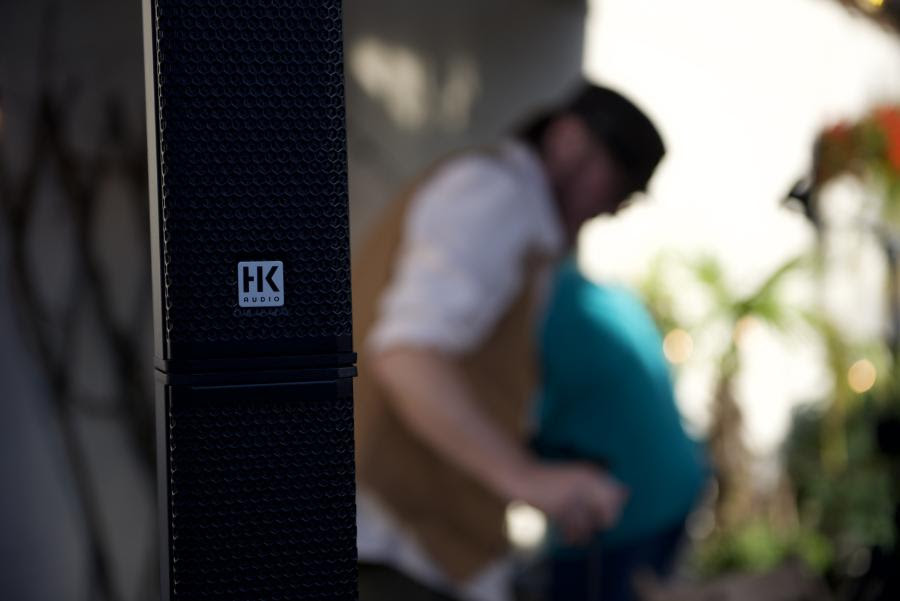
The tour used a pair of HK Audio POLAR 10 MK2 column loudspeakers. The systems came through POLAR, HK Audio’s UK distributor, which suits a tour that landed in Britain from overseas, since the gear was already in the country.
If “column loudspeaker” is new to you, it’s a tall, slim speaker built from a vertical line of small drivers (the individual speaker cones) rather than one big cabinet with a large woofer. Columns of this type are generally designed to spread sound widely from side to side while keeping it controlled up and down. In practice, that tends to put more of the sound onto the audience and less onto the ceiling and floor, which helps in low-ceilinged rooms like pubs. Check the manufacturer’s specifications for the exact behavior of any model you’re considering.
Using two units rather than one matters too. A pair gives you a left and right side, so the sound can cover more of the room and you aren’t blasting the front row to reach the back.
 Photo by Jonathan Borba / Pexels
Why Bring Your Own PA to Pub-Style Gigs
When a venue has no house system, you have three choices: play unamplified, rely on whatever ad hoc gear the room’s owner has, or carry your own. Acoustic and roots-leaning acts with vocals at the center can’t always get by unamplified, especially once a room fills with people and conversation. A dependable rig of your own removes the guesswork, because you know what you’re plugging into every night.
There’s a consistency benefit as well. On an eight-date run through different regions, every room is different in size, shape and surface. Carrying the same speakers means one variable stays fixed. You may still adjust your sound for each space, but you start from a known baseline instead of learning a new system at every soundcheck.
Local distribution helps with all this. Sourcing gear through a distributor in the country you’re touring can simplify logistics for an overseas act, which is presumably why the tour used the UK distributor’s systems.
Practical Lessons for Small Bands
A few of these points come straight from the tour’s setup. The rest are standard good practice for a trio working in rooms without a house PA.
Match the system to the room, not to your ego. A compact column system is designed for intimate venues. If you play pubs, you rarely need more than that, and a smaller rig is easier to carry, set up and tear down.
Think in pairs. Two speakers placed on either side of the playing area give you a wider spread and let you keep the volume lower than a single speaker would require. Lower volume usually means less feedback, the howling or ringing that happens when a microphone picks up its own amplified signal.
Keep the setup simple. With three musicians and no sound engineer in the room, every extra piece of gear is another thing that can fail or slow you down. Plan your signal chain so that anyone in the band can plug in and get going.
Put the speakers in front of the microphones. A common rule for any PA is to place speakers ahead of the vocal mics, so the sound travels away from them instead of back into them. This reduces feedback and lets you hear more of the band in the room naturally.
Check the room from the audience’s side. Once the rig is up, walk the venue while a bandmate plays or sings. What sounds fine on stage may sound very different at the back, near the bar, or in a corner.
 Photo by Adrienn Pamuk / Pexels
A Quick Checklist for Your Own Run
If you’re planning a short run through small venues that don’t provide sound, here’s a way to get ready:
- Confirm what each venue offers. Don’t assume a pub has a PA, or that it works. Ask ahead of time, and treat “no sound system” as a real possibility.
- Pack for the smallest, trickiest room. If your rig works in a cramped corner, it will work almost anywhere else.
- Decide who runs sound. In a three-piece with no engineer, someone in the band needs to own the mix, or you need a simple, repeatable setup everyone understands.
- Do a short soundcheck every night. Even with the same speakers, rooms change the result. A few minutes of testing at each stop beats finding problems mid-set.
- Sort out gear supply early. If you’re traveling from abroad, work out in advance how you’ll get a PA, whether through a distributor, a rental company or a local contact, rather than leaving it until you land.
The Takeaway
Richie Owens’ UK tour shows a sensible approach for small acts: when the rooms don’t supply sound, bring a compact system of your own and use it consistently. A pair of column loudspeakers, a trio that knows its setup, and a plan for where the gear will come from make a run of pub and small-venue shows far easier to manage. You don’t need a large rig. You need one that fits the rooms you actually play and that you can rely on every night.
Sources
Singer-Songwriter Richie Owens Takes Appalachian Music To UK Pubs With HK Audio, www.prosoundweb.com