Soundbar Reality Check: How Your Immersive Mix Sounds At Home

On this page
Soundbar Reality Check: What Your Immersive Mix Sounds Like in a Living Room
Most Listeners Aren’t Hearing Your Studio
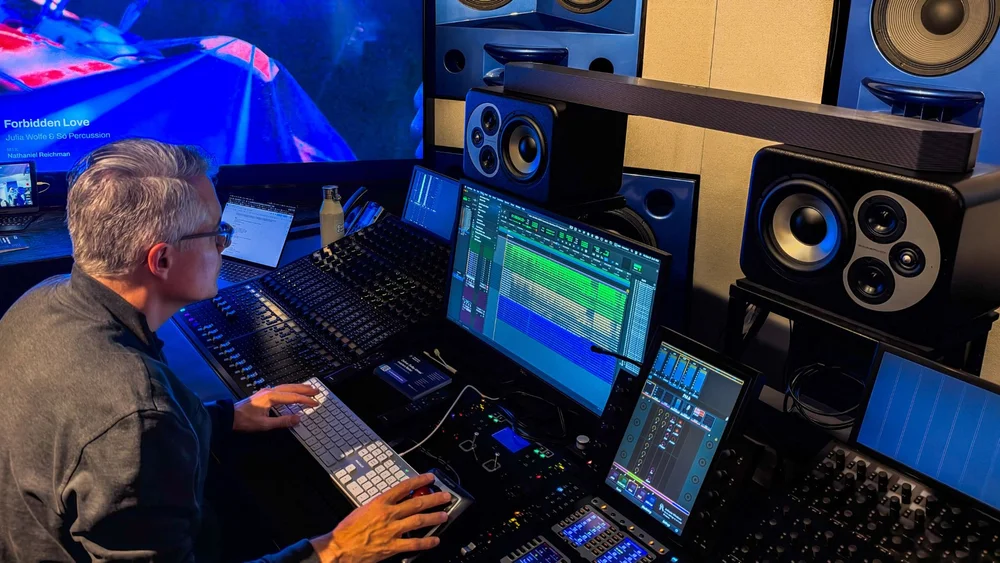
Mixing in Dolby Atmos (a format that treats sounds as “objects” you can place anywhere in a 3D space, rather than assigning them to fixed speakers) is a thrill in a well-built room. That excitement can make us brush off an awkward question: what does a normal listener actually hear?
Mixer Nathaniel Reichman admits he used to deflect it with lines like “it sounds great in a car!” or “tons of people have home theatre systems!” Those answers don’t hold up well. Newer high-end cars do sound impressive, but few people own a true home theatre, meaning separate amplifiers, discrete speakers, and an Atmos-capable receiver. For most listeners, immersive music arrives through a soundbar.
A soundbar sits between a TV’s built-in speakers and a full speaker system. Reichman first heard the Sennheiser Ambeo and early Sonos models and wasn’t won over, but he could hear where the technology was headed. He kept listening whenever he could. That’s harder than it sounds, because soundbars lean on the walls and ceiling of a small or medium room to do their work. An echoey electronics showroom with background noise tells you very little.
 Via production-expert.com
The Test Setup
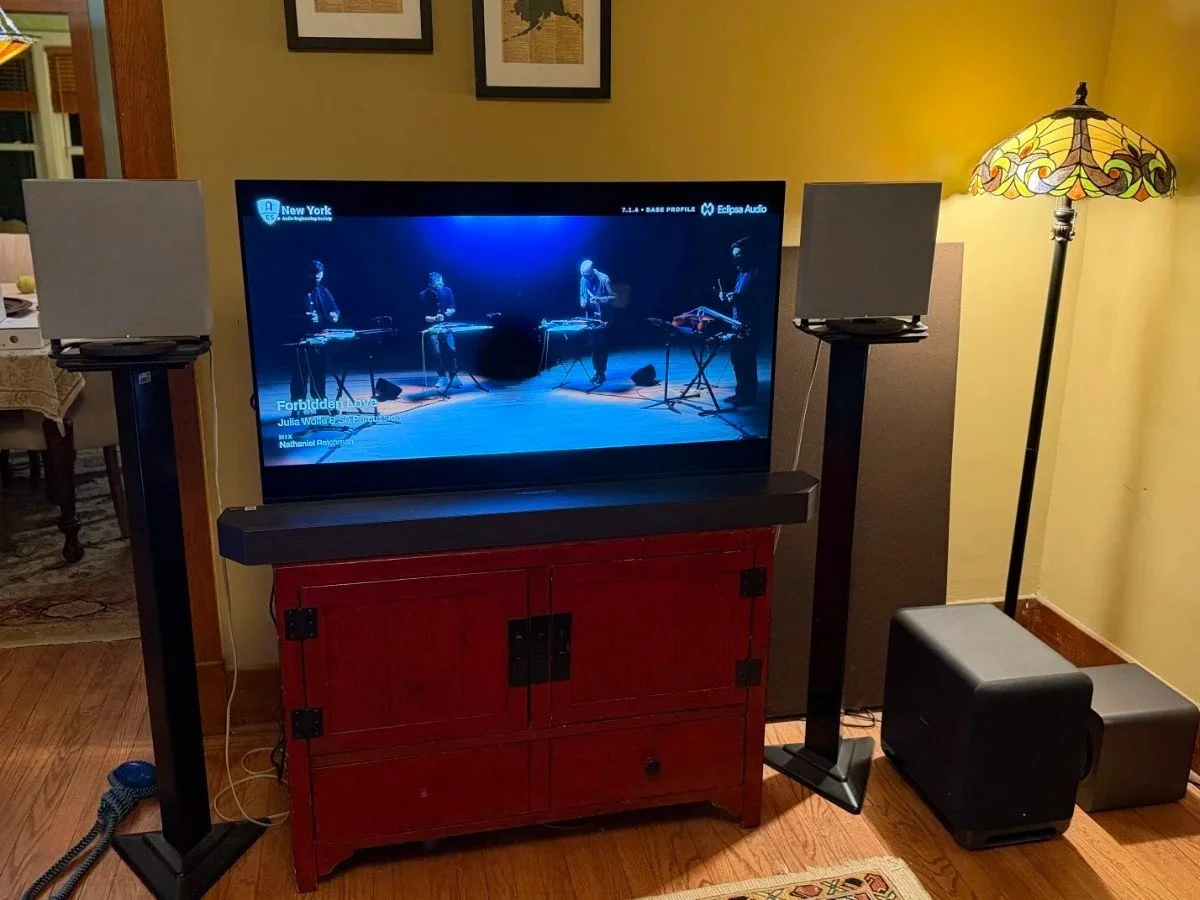
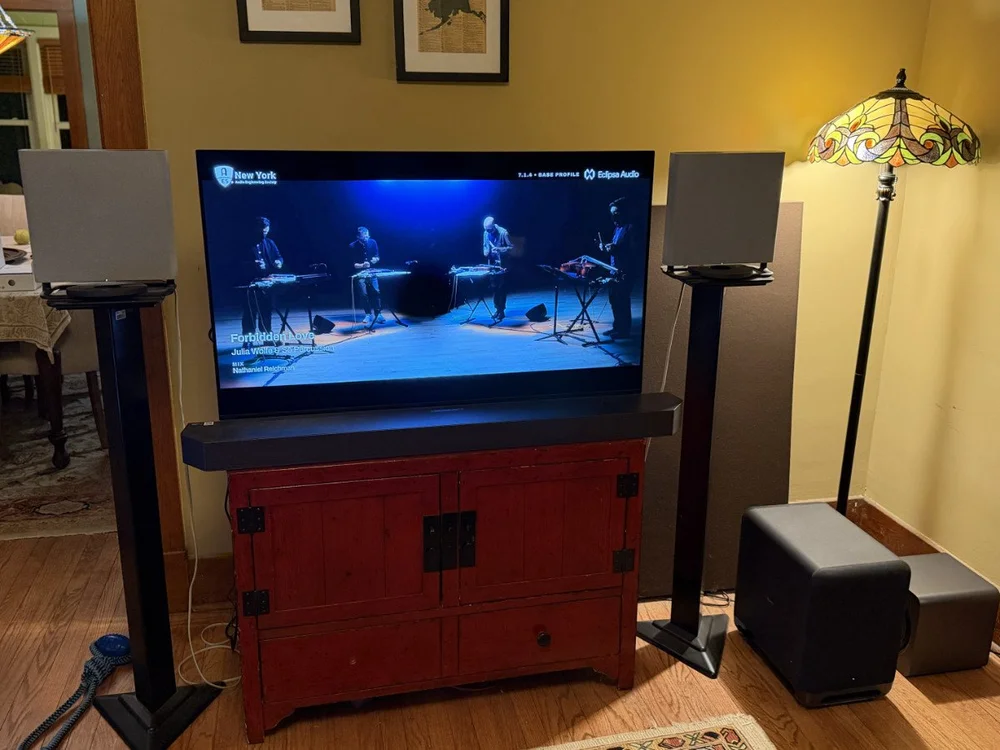
Reichman eventually bought a Sony Bravia Theater Quad for his own living room. It was good enough that a picky audiophile wouldn’t resent it, yet common enough to reveal how his mixes translate to ordinary homes. Ahead of an Immersive Machines event in New York, he also borrowed Samsung’s flagship soundbar and set up both systems for a direct comparison.
Price matters here. A $300 soundbar is a big step up from TV speakers, but quality jumps again at the top of the range. The two contenders were the Samsung HW-Q990H at around $1,700 USD and the Sony Bravia Theater Quad at roughly $2,300 USD.
To keep things fair, he:
- Connected identical Apple TV boxes to each system
- Placed both systems side by side
- Played a broad mix of albums and films
- Included albums he had mixed himself, so he knew exactly how the lossless ADM file (the master file format for Atmos mixes) sounded in the studio
- Added recent releases known for using the Atmos soundfield well
The headline is that both sound good, which you’d expect at this price. They are big and dynamic, you can clearly hear objects travel through the room, and the tonal balance is even. He credits that last point to their bass management, the processing that decides which frequencies go to the subwoofer and which stay with the main speakers. Beyond that, the two take very different routes to the same goal.
Two Philosophies, One Living Room
The Samsung is the traditional design. A wide, low, heavy bar sits beneath the TV. A subwoofer and two rear surround speakers complete the set, and the surrounds are meant to go on stands behind the listening position.
Sony skips the central bar. Its system uses four square panels, each packed with small drivers, plus a subwoofer and a wireless control box. You place the panels around the room as you like. The best spots turned out to be left and right of the TV and, surprisingly, at the side surround positions. Reichman tried the second pair behind him in the rear surround spots, but the soundstage was better with them at the sides.
If you plan to evaluate a system like this, don’t assume the manual’s suggested layout is the best one. Move the speakers around and listen again.
 Via production-expert.com
Dialogue and the Centre Channel
Reichman has watched TV on the Sony for a couple of years and grew used to its “virtual” centre channel. The panels work together to project a phantom speaker into a spot where no physical speaker exists. It’s clever, and it works fairly well.
Then he watched the same show on the Samsung, which has a real centre channel, and heard what he’d been missing. Voices had more body and a more natural tone. The Sony does a respectable job of anchoring dialogue to an actor’s mouth, but the Samsung wins on this point.
There’s a footnote. The Sony can use the speakers of a connected Sony Bravia TV as an actual centre channel. Reichman tried it on his own Bravia, and it sounded worse than the virtual version. He suspects that says more about the TV’s built-in speakers than about the feature.
For mixers, the lesson is that dialogue and anything else panned to the centre can sound different from system to system. A lead vocal sitting in the middle of your mix may gain or lose weight depending on how the soundbar handles that position.
Surrounds and Heights
Both systems fill the room convincingly, but a closer look reveals limits. Reichman played test tones through each channel of the seven-speaker horizontal layer, using his favourite test disc, “Functional Testing” from Dolby Labs. The difference between a side surround and a rear surround was weak on both. A tone moving from left surround to left rear surround, or right to right rear, wasn’t clearly defined.
That surprised him on the Sony, because he can easily hear objects flying around the room with it. The Samsung, meanwhile, gets a lot out of its modest-looking rear speakers.
Height is where both systems impress. They fire sound upward to bounce off the ceiling in a tightly directed way, and it genuinely reads as an overhead channel. It’s a little washy, but it’s unmistakable. If your mix has a guitar solo swirling overhead or a sudden office PA announcement, listeners with these systems will notice.
What to Take Back to Your Studio
Some practical takeaways follow from all this:
- Audition mixes on a real soundbar. If you can’t afford a flagship model, borrow a friend’s or use a room where you can listen without crowd noise.
- Check your centre content. Because systems handle the centre differently, confirm that vocals and dialogue hold up on a virtual centre as well as a physical one.
- Don’t rely on fine front-to-back distinctions. Moves between side and rear positions may blur at home, so make big gestures obvious.
- Height works, with softer edges. Overhead placement survives translation, but don’t count on pinpoint precision.
- Test with music you know. Familiar mixes, especially your own, make differences easy to hear.
Reichman’s findings also challenge some common assumptions about how immersive music should be mixed. The most useful habit is to stop guessing and listen to your work on the kind of system most people own.
Sources
Soundbar Reality Check: How Your Immersive Mix Sounds At Home, www.production-expert.com