Toontrack Releases Neon Void EKX For EZkeys 2

On this page
Neon Void EKX Brings Dark Synths and Cinematic FX to EZkeys 2
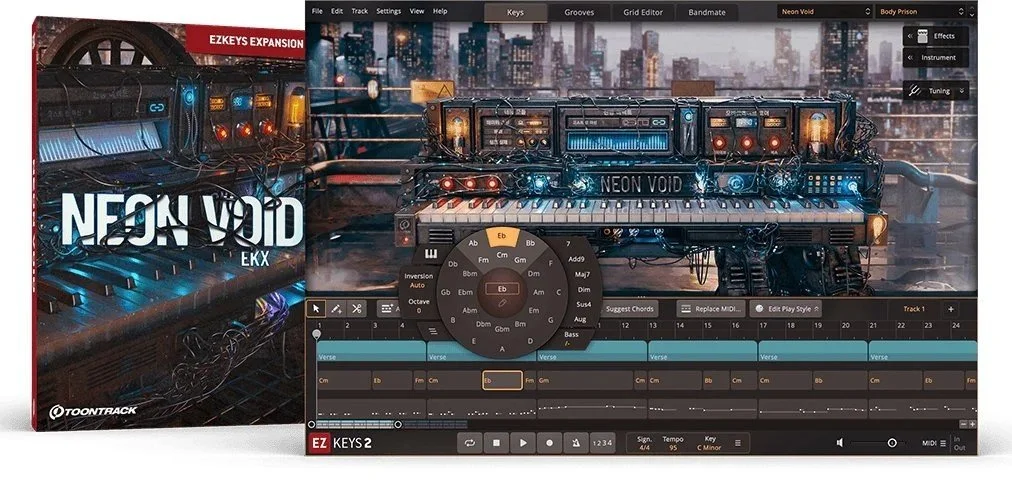
Toontrack has released Neon Void, a new EKX (the company’s name for an expansion library) for its EZkeys 2 songwriting instrument. The sound set leans dark: heavily processed synths, gritty textures and cinematic effects. It targets people making darkwave, synth-heavy industrial metal and sci-fi-flavored scores, genres where the melodic parts and the transitional sound design often have to come from the same palette.
What’s in the Box
Neon Void has two main halves, plus a bonus.
- 67 playable presets. These cover keys, pads, textures, leads and basses.
- A separate transition FX set. It holds subs (deep low-frequency rumbles), impacts and hits (punchy accents that mark a change of section), risers (sounds that build tension toward a transition), and other cinematic effects.
- A MIDI library of “songs.” These were written specifically around the sounds in this expansion.
The sounds are designed for industrial rock and metal, dark electronic music and cinematic soundscapes. Toontrack describes the overall character as raw, dense and visceral, so expect weight and grit rather than polish.
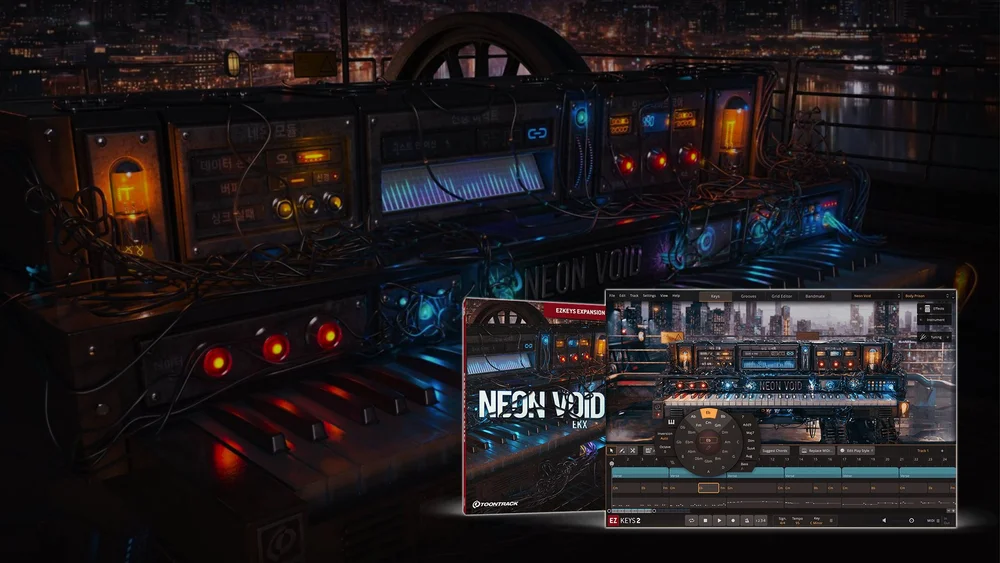 Via production-expert.com
Melodic Parts and Transitions From One Source
Neon Void runs inside EZkeys 2, so you get the host’s songwriting and MIDI tools along with the new sounds. You don’t need a separate workflow to audition them.
The 67 presets range from large synth patches to sparser, more organic textures. That gives you room to build a full arrangement, from a heavy bass line to a thin atmospheric bed under a verse.
The FX set sits in the same instrument as those parts, not in a separate sample library. The practical payoff is tonal consistency. Melodic material and transition effects are designed to sit together, so a riser leading into a chorus shares a sonic family with the pad or lead it’s introducing. If you’ve ever auditioned a stack of unrelated risers and impacts to find ones that don’t clash with your synth sounds, you’ll see the appeal. It matters most if you’re producing on a regular release schedule and want fewer decisions per track.
How the Synth Sounds Were Made
The core synth material started on a range of classic hardware instruments and outboard gear. Outboard gear means external hardware processors, such as compressors and effects units, that sit outside a computer. Toontrack mixed and layered those sources, then saturated them (added harmonic distortion and thickness) to create new composite sounds.
According to Toontrack, the goal was to set analogue character against more otherworldly tones. The preset categories reflect that range. You’ll find conventional keys and basses, and you’ll also find evolving pads and textures that shift over time.
If you write in the darker electronic or industrial space, this layered approach matters. Single-source synth patches can sound thin in a dense mix. Sounds that were already stacked and saturated at the source tend to arrive with more built-in body.
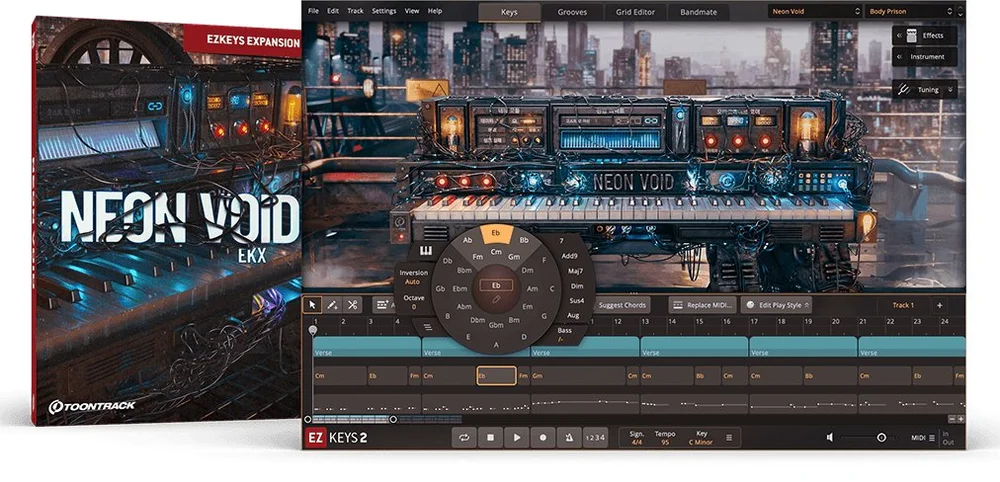 Via production-expert.com
Contact Mics, Foley and Modular Synthesis in the FX Layer
The effects half took a different route. Toontrack combined modular synthesis with extensive foley sessions.
- Modular synthesis means building sounds from separate, patchable hardware modules rather than a fixed-architecture synthesizer.
- Foley is the practice of recording real-world sounds, here everyday objects that were bowed, struck, scraped and rubbed.
The recordings used contact microphones. A contact mic picks up vibration through direct physical contact with an object, not through the air the way a regular microphone does. That let Toontrack capture resonances and vibrations that conventional mics would miss. The recordings were then layered, pitched and processed into finished textures.
Processing across the library includes granular effects, distortion and compression. Granular processing chops audio into tiny fragments and rearranges them, which tends to produce smeared, shimmering or fractured results. Combined with distortion and compression, it gives the material the dense, tense character Toontrack says suits tension-building passages and sci-fi sound design.
Using the Bundled MIDI Songs
The included MIDI songs were written with this library’s presets in mind. The parts are voiced and paced for these specific textures, not generic keyboard patterns that you’d have to adapt.
There are two sensible ways to use them:
- As starting points. Load a song, hear how the parts and sounds interact, and build a new arrangement from there.
- As raw material. Break the songs apart and rebuild them using EZkeys 2’s own MIDI workflow. MIDI is just note and timing data, so you can reassign it to different presets, rearrange sections or pull out a single part that works for your track.
If you’re stuck on how to voice dark synth parts, studying the supplied songs is a quick way to see what the sound designers had in mind. You can then bend those ideas to fit your own material.
Pricing and Availability
Neon Void EKX is available now for 89 Euros. It requires EZkeys 2, so it won’t work as a standalone product. If you already use EZkeys 2 and write in darkwave, industrial or cinematic styles, it’s the audience Toontrack had in mind.
Sources
Toontrack Releases Neon Void EKX For EZkeys 2, www.production-expert.com