Vienna Performer Renders MIDI With Real Players For €9.99 A Month

On this page
Vienna Performer: A Subscription That Turns Your MIDI Into a Played Performance
Vienna Symphonic Library (VSL) has released Vienna Performer, a plugin that takes the MIDI you’ve written and renders it as a performance by real players. It’s sold by subscription, starting at €9.99 a month. VSL pitches it as an add-on to the sample libraries you already own, not a substitute for them. Here is what it does, what it needs, and how the pricing works.
What the Plugin Actually Does
MIDI is the note data a keyboard or DAW (digital audio workstation, your recording software) stores: which pitches, when, and how long. Vienna Performer reads that data and renders audio that sounds played. It adds phrasing, breath, bow direction, vibrato and timing. It does not compose or invent notes. Whatever you wrote is what gets performed.
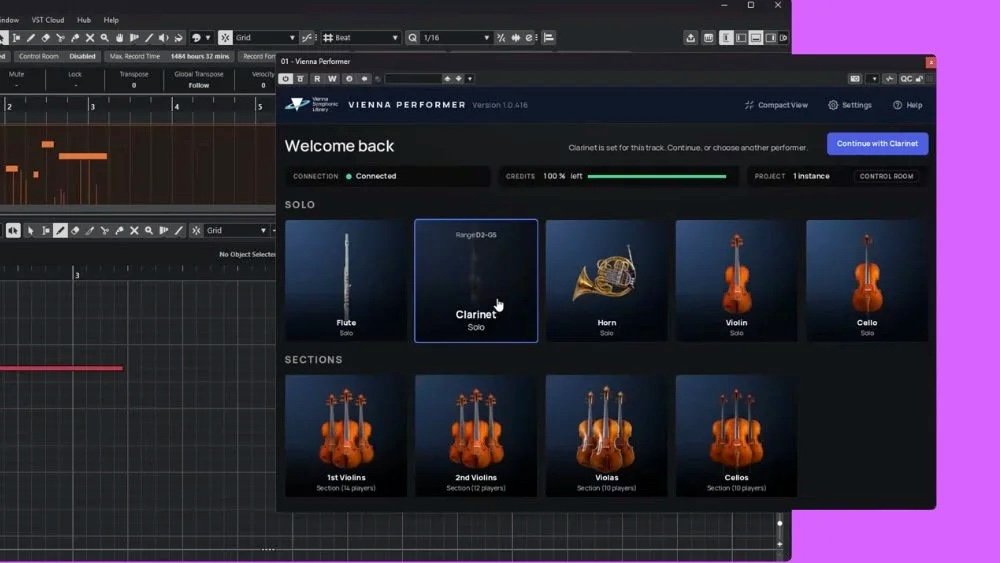
The plugin has nine instruments at launch. Five are solos: violin, cello, flute, clarinet and French horn. The other four are string sections: first violins, second violins, violas and cellos, recorded at their real-world section sizes. Everything was recorded at Vienna Synchron Stage, the same space behind VSL’s Synchron libraries, so the sound should sit comfortably next to them.
Two more are on the way. A solo trumpet and a double bass section are in production, and VSL says they will arrive within existing plans, so you won’t pay extra for them.
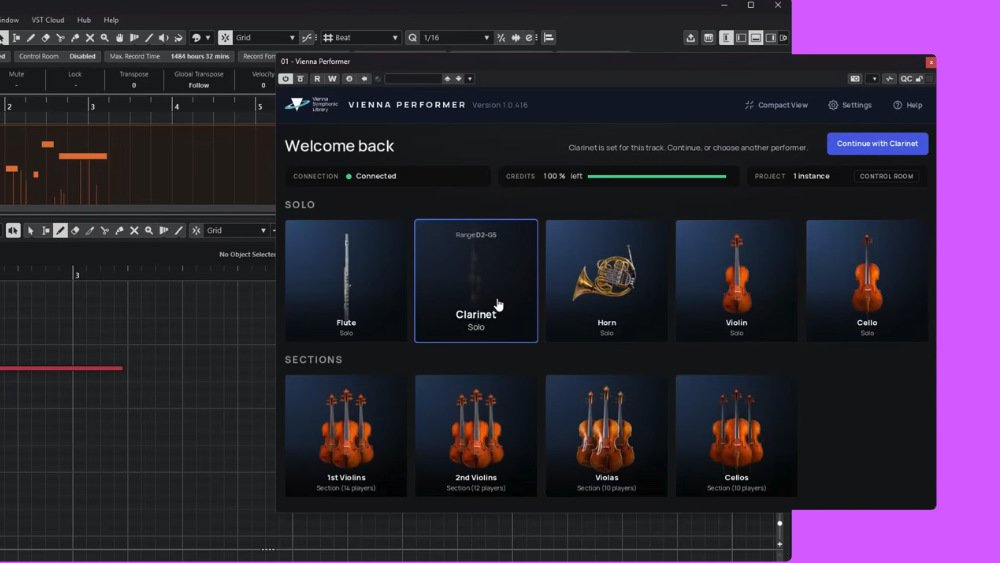 Via production-expert.com
Getting Your Notes In
You have several ways to feed it music:
- a MIDI file
- a track in your DAW
- live MIDI sent from the host (the program running the plugin)
- MusicXML, a common interchange format for notated scores
- scores opened directly in Dorico or Sibelius, two notation programs
It runs as VST3, AU and AAX, the three main plugin formats, on macOS 12 or later and on Windows 10 or 11. There is no standalone app. The plugin is meant to live inside the program where your notes already are.
Some practical requirements:
- You need a VSL account with an active subscription.
- No iLok is involved. An iLok is the USB-based copy-protection key some plugin makers require.
- Rendering needs an internet connection.
- Renders already saved on your machine play back without one.
- Output is saved as FLAC files, a lossless audio format, into a render folder you choose.
So you can do the rendering while online and then work offline with the saved files.
How the Minutes Add Up
Vienna Performer meters usage in performance minutes, meaning minutes of rendered audio. The counting has a catch: each musical phrase is rounded up to the next ten-second step. A phrase that runs a few seconds past a boundary is billed as the next full step. If you render lots of short phrases, the rounding will eat into your allowance faster than the raw audio length suggests. Rendering longer passages in one go is the sensible way to waste less.
All three plans have the same features. The only difference is how many minutes you get each month. All prices include VAT (value-added tax):
| Plan | Minutes per month | Monthly price |
|---|---|---|
| Entry | 140 | €9.99 |
| Standard | 360 | €19.99 |
| Pro | 1,000 | €49.99 |
Yearly billing charges you for ten months and gives you twelve. That comes to €99.90 for Entry, €199.90 for Standard and €499.90 for Pro. Your minutes arrive on your billing day, not on the first of the calendar month, so plan around your own billing date.
Monthly subscriptions can be cancelled at any time.
 Photo by David Maat / Pexels
It Adds to Your Libraries, It Doesn’t Replace Them
VSL is clear that Vienna Performer is not a sample library. It plays the notes you give it. Articulation choices (the playing styles a library offers, such as long notes or short ones), microphone setup and room choice all stay with the libraries already installed on your drive. Its job is the human side of the performance. It doesn’t replace the instrument sounds.
For people running Synchron libraries, VSL’s suggestion is simple: add Vienna Performer as another instrument track in your current template. In Dorico you can add it directly to a playback configuration. It also works inside Vienna Ensemble Pro 8, VSL’s tool for hosting instruments in a separate program. It is not supported in Vienna Ensemble Free 7, so check which version you’re on.
The company quotes early users who say it’s efficient at removing programming work, meaning the manual tweaking of MIDI data to make virtual instruments sound human. One of them says it would take an accomplished instrumentalist to compete with it at full potential. Those are testimonials chosen by the vendor, so test it on your own material before taking them as given.
The Business Model and the Data Questions
Subscriptions are a change for VSL, whose software has been sold outright until now. Vienna Ensemble Pro 8 costs €199, and Synchron libraries are priced individually. Anyone used to paying once and owning the product will notice the difference. If you stop paying, you lose the ability to render new material, though files you’ve already saved remain on your drive.
VSL also makes several claims about how this differs from generative music tools, which pump out new music from a text prompt. According to the company:
- It does not train on your material.
- It acquires no rights in your material.
- It stores neither your MIDI nor your renders.
VSL describes the plugin as AI-assisted in the same sense as AI-assisted mixing tools. It works from note-level input, the actual notes you wrote, and not from a prompt. These are the company’s own statements about its practices, and they are worth reading alongside the terms of service if you work on client projects.
Vienna Performer is available now from Vienna Symphonic Library. Start with the Entry plan to see whether your workflow suits the minutes model. You can move up if your renders eat through the allowance.
Sources
Vienna Performer Renders MIDI With Real Players For €9.99 A Month, www.production-expert.com